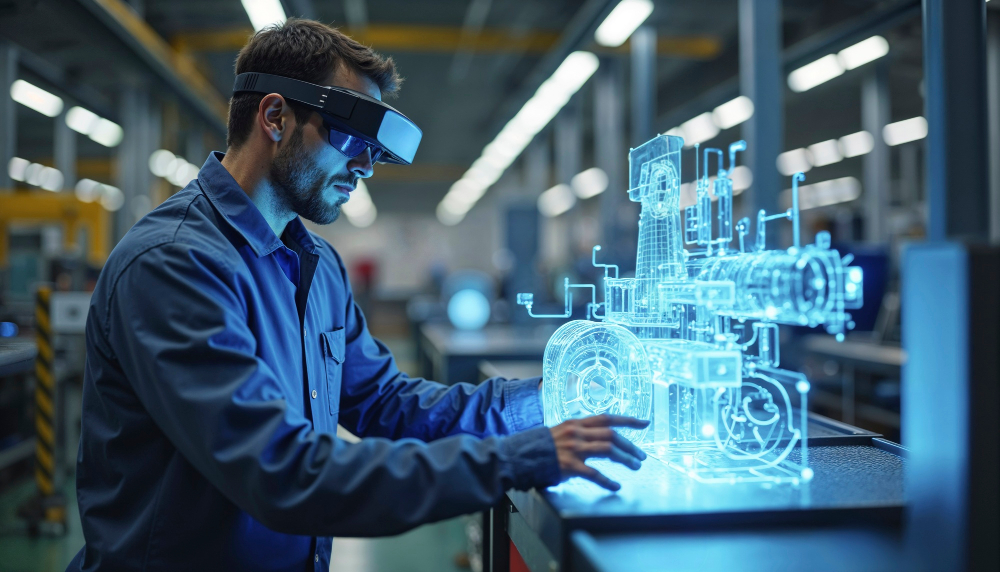
Engineering is entering its most transformative decade in a century. Not because the laws of physics changed—but because the tools, expectations, and constraints around engineering have changed.
Customers want faster delivery cycles. Governments demand safer infrastructure. Industries are racing toward net-zero. And every product—from a valve to an EV to a refinery—now generates data that can feed back into better design.
The future engineer is becoming a hybrid: builder + analyst + systems thinker + collaborator.
1) The engineering economy is getting bigger—and more specialized
Engineering isn’t just “projects” anymore. It’s becoming an always-on service model: simulation, optimization, predictive maintenance, lifecycle upgrades, compliance, documentation, digital commissioning.
A few numbers show how large the opportunity is:
-
The global engineering services market was estimated at USD ~3.42 trillion (2024) and projected to reach USD ~4.72 trillion by 2030.
-
Global Industry 4.0 adoption (smart factories, automation, connected systems) is accelerating—one estimate values the market at USD ~188.5B (2025) and forecasts USD ~599.2B by 2034.
What it means: engineering firms and manufacturers that package expertise into scalable services (design + analysis + supply + delivery) will win bigger deals—globally.
2) Digital twins become “default,” not “advanced”
A digital twin is no longer a fancy dashboard—it’s the future operating system for physical assets.
-
The digital twin market is estimated at USD ~35.82B (2025) and projected to reach USD ~328.51B by 2033.
In practical terms, this changes how engineering teams work:
-
Design is validated virtually before cutting metal
-
Maintenance becomes predictive, not reactive
-
Assets are optimized continuously (efficiency, safety, uptime)
3) Industrial IoT + AI turns plants into “self-improving” systems
Sensors are becoming cheap. Connectivity is becoming standard. AI is becoming usable by teams without deep research backgrounds.
-
The Industrial IoT (IIoT) market was estimated at USD ~483.16B (2024) and projected to reach USD ~1.69T by 2030.
The biggest shift is cultural: engineering decisions will increasingly be driven by real operating data, not just assumptions and legacy standards.
4) Manufacturing goes faster with 3D printing and hybrid fabrication
Additive manufacturing is moving from prototyping to production—especially in aerospace, medical, energy, and spares.
-
The additive manufacturing market was USD ~20.37B (2023) and projected to reach USD ~88.28B by 2030.
Why it matters for engineering businesses:
-
Shorter development cycles
-
Lower inventory (print on demand spares)
-
Better part performance through geometry you can’t machine traditionally
5) Sustainability becomes an engineering spec, not a marketing line
The next era of engineering is inseparable from the energy transition and resource efficiency.
-
Global energy investment was projected to hit a record USD ~3.3T in 2025, with around two-thirds (~USD 2.2T) going to clean energy technologies.
This drives demand for engineering in:
-
renewables, grids, storage, hydrogen
-
low-emission process design
-
water & wastewater, circular manufacturing
-
materials engineering and lifecycle analysis
6) Infrastructure demand will reshape engineering workloads worldwide
Population growth + urbanization + climate adaptation = massive construction and retrofit cycles.
-
Global infrastructure investment needs were estimated at ~USD 94 trillion (2016–2040).
This will pull engineering talent into:
-
resilient design (flood/heat/earthquake readiness)
-
faster project execution (modularization, digital workflows)
-
compliance-heavy, safety-critical systems
7) The skills engineers need are shifting fast
Tools will change. The fundamentals stay. But the “career edge” is evolving.
The World Economic Forum expects significant job churn by 2030:
-
170 million new roles created and 92 million displaced (net +78 million).
Future-ready engineering skill stack:
-
simulation + data interpretation
-
automation + controls thinking (even if you’re not a programmer)
-
cybersecurity awareness for industrial systems
-
communication, documentation, and cross-team leadership
-
supply chain + vendor collaboration skills
The biggest opportunity: engineering + networking + speed
The future of engineering belongs to teams who can:
-
Build high-quality outcomes,
-
Move faster with digital workflows, and
-
Win work globally through visibility + trusted networks.
That’s where a B2B ecosystem matters—especially for manufacturers, stockists, EPC players, and service providers who want consistent business leads and partnerships.
ENGGPRO helps engineering companies showcase and discover B2B products/services, connect with buyers, and build business networks at scale: