Introduction
“Stainless steel” isn’t one material — it’s a family of alloys with meaningfully different properties, and picking the wrong grade can mean premature corrosion or unnecessary cost. This guide breaks down the most commonly specified stainless steel plate grades in industrial procurement.
SS 304
The most widely used austenitic stainless steel grade, offering good corrosion resistance and formability at a relatively economical cost.
Best for: General industrial use, food processing equipment, architectural applications, equipment not exposed to chlorides or harsh chemicals
SS 316
Contains molybdenum, which significantly improves resistance to chlorides and industrial chemicals compared to 304.
Best for: Marine environments, chemical processing, pharmaceutical equipment, coastal installations — anywhere higher corrosion resistance justifies the added cost over 304
SS 321
A stabilized grade (titanium-stabilized) that resists carbide precipitation at high temperatures, making it suitable for sustained heat exposure.
Best for: High-temperature applications — exhaust systems, furnace parts, aerospace components, and welded structures operating in the 425–900°C range
Duplex Stainless Steel (2205)
A mixed austenitic-ferritic structure that combines higher strength than standard austenitic grades with strong corrosion resistance, particularly against stress corrosion cracking.
Best for: Oil & gas, chemical processing, and applications needing higher mechanical strength alongside corrosion resistance — often allows thinner sections than 304/316 for the same structural requirement
Super Duplex (2507)
An enhanced duplex grade with higher chromium, molybdenum, and nitrogen content, offering superior resistance to pitting and crevice corrosion.
Best for: Highly aggressive environments — offshore oil & gas, desalination plants, and applications with high chloride exposure where standard duplex isn’t sufficient
Quick Comparison
| Grade | Corrosion resistance | Strength | Typical use | Relative cost |
| 304 | Good | Standard | General industrial, food-grade | Lowest |
| 316 | Very good (chlorides) | Standard | Chemical, marine, pharma | Moderate |
| 321 | Good + high-temp stable | Standard | High-temperature applications | Moderate |
| Duplex 2205 | Very good | High | Oil & gas, chemical processing | Higher |
| Super Duplex 2507 | Excellent | Very high | Offshore, highly corrosive environments | Highest |
How to Choose the Right Grade
Three factors drive most grade decisions:
- What’s the operating environment — general use, chloride/marine exposure, or high temperature?
- What mechanical strength does the application require — standard structural use, or higher strength needed to reduce material thickness?
- What’s the project’s compliance requirement — some industries (pharma, food processing) have specific grade requirements written into project specs
Thickness, Finish and Tolerance Considerations
Grade is only one part of a stainless steel plate specification. Also confirm:
- Thickness and tolerance — confirm the acceptable tolerance range for your application; tighter tolerances typically cost more and may limit which mills/stockists can supply
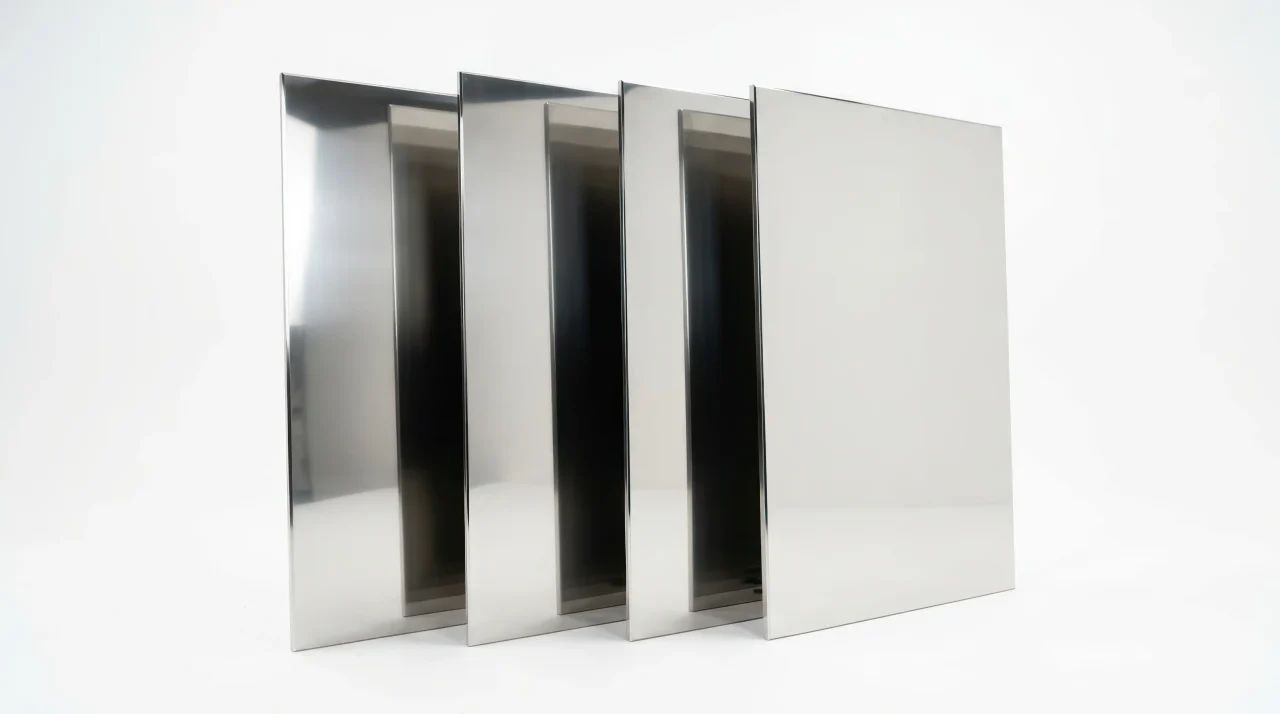
- Surface finish — options range from hot-rolled/mill finish (economical, functional applications) to polished finishes like 2B, No. 4, or mirror finish (used where appearance or hygiene matters, such as food/pharma equipment)
- Plate size — standard mill sizes are more readily available and economical; custom sizes may require cutting charges or longer lead times
Typical Cost Factors for Stainless Steel Plates
- Grade — as the comparison table above shows, cost generally increases from 304 through 316, 321, duplex, to super duplex, driven by alloying element content (nickel, molybdenum, chromium)
- Thickness — thicker plates cost more per unit area and may have longer lead times depending on mill availability
- Finish — polished and specialty finishes add processing cost over standard mill finish
- Market pricing volatility — stainless steel pricing is tied to nickel and chromium commodity markets, which can fluctuate significantly; for large orders, ask suppliers whether pricing is fixed at quote or subject to market-linked adjustment at delivery
Getting current pricing requires a live quote against your exact grade, thickness, and finish — stainless steel commodity pricing changes too frequently for general estimates to be reliable.
Frequently Asked Questions
Is 316 always better than 304?
Not necessarily — 316 offers better chloride resistance but at higher cost; for applications without chloride or chemical exposure, 304 is often the more cost-effective and entirely adequate choice.
Can duplex grades replace 316 in all applications?
Not always — while duplex often allows thinner sections due to higher strength, it can be more difficult to weld and fabricate, so the full picture (fabrication cost, not just material cost) should factor into the decision.
How do I verify the grade of a stainless steel plate I’m sourcing?
Request material test certificates (MTCs) showing chemical composition and mechanical properties for each batch — don’t rely on supplier claims alone for critical applications.
Source Verified SS Plate Stockists on Enggpro
Post your stainless steel plate requirement on Enggpro to receive quotes from verified stockists, or browse live SS plate RFQs and tenders.