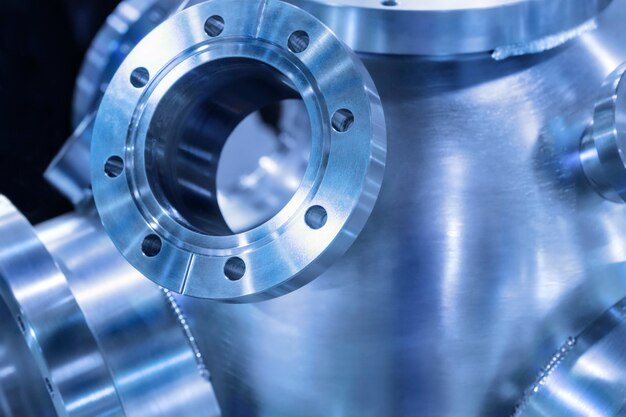
Flanges are integral components in various industries, serving as vital connectors for pipes, valves, pumps, and other equipment. They facilitate the assembly and disassembly of piping systems, allowing for maintenance, inspection, and modifications. Understanding the different types of flanges and their specific applications is crucial for selecting the appropriate flange to ensure system integrity and efficiency.
Types of Flanges and Their Applications
1. Weld Neck Flange
Weld Neck Flanges are characterized by a long, tapered hub that provides reinforcement to the connection, making them suitable for high-pressure and high-temperature applications. The flange is butt-welded to the pipe, ensuring a smooth transition and reducing stress concentrations. This design minimizes turbulence and erosion, making it ideal for critical services.
Applications:
- High-pressure pipelines in oil and gas industries
- Chemical processing plants
- Power generation facilities
- Marine applications
2. Slip-On Flange
Slip-On Flanges have a bore slightly larger than the pipe’s outer diameter, allowing the pipe to slip into the flange before welding. They are fillet welded both inside and outside to provide sufficient strength. These flanges are easier to align and install, making them a cost-effective choice for low-pressure applications.
Applications:
- Low-pressure fluid transportation
- Cooling water lines
- Fire-fighting systems
- Process piping in industries
3. Socket Weld Flange
Socket Weld Flanges feature a socket into which the pipe is inserted and then fillet welded. They are typically used for small-diameter, high-pressure piping. The smooth bore and good flow characteristics make them suitable for applications where internal cleanliness is important.
Applications:
- High-pressure steam lines
- Hydraulic systems
- Chemical processing
- Gas lines
4. Threaded Flange
Threaded Flanges have internal threads that match the external threads of the pipe. They are used in systems where welding is not feasible or desirable, such as in explosive environments. Threaded flanges are suitable for low-pressure and low-temperature applications.
Applications:
- Utility services like air and water
- Fire protection systems
- Explosive atmospheres
- Temporary connections
5. Blind Flange
Blind Flanges are solid discs used to close off the end of a piping system or vessel. They allow for easy access to the interior of a line or vessel once it has been sealed. Blind flanges can withstand high pressure and are also used for pressure testing.
Applications:
- Pressure vessel closures
- Manhole covers
- Inspection ports
- Testing of piping systems
See Also Top Flanges Manufacturers in India: A Comprehensive Guide for Industry Professionals
6. Lap Joint Flange
Lap Joint Flanges are used in conjunction with a stub end, which is butt-welded to the pipe, while the flange itself is not welded or fixed to the pipe. This design allows the flange to rotate freely, facilitating easy alignment of bolt holes during assembly. Lap joint flanges are ideal for systems requiring frequent disassembly.
Applications:
- Systems requiring frequent maintenance
- Low-pressure applications
- Non-critical services
- Piping systems with limited space
7. Long Weld Neck Flange
Long Weld Neck Flanges are similar to weld neck flanges but have an extended neck, which acts as a boring extension. They are typically used in place of a weld neck flange and a piece of pipe for bolt-up connections to vessels or columns.
Applications:
- Pressure vessels
- Heat exchangers
- Column connections in process plants
- High-pressure applications
8. Reducing Flange
Reducing Flanges are used to connect pipes of different diameters. They have a flange with one specified diameter and a bore of a different, usually smaller, diameter. This allows for a smooth transition between pipes of varying sizes.
Applications:
- Connecting different pipe sizes
- Flow control systems
- Process piping
- Pump inlet and outlet connections
9. Orifice Flange
Orifice Flanges are used in conjunction with orifice meters to measure the flow rate of liquids or gases in a pipeline. They have provisions for meter connections and are typically used in metering systems.
Applications:
- Flow measurement in pipelines
- Metering systems in process industries
- Custody transfer systems
- Energy management systems
10. Spectacle Blind Flange
Spectacle Blind Flanges consist of a connected pair of discs, one solid and the other with a hole, resembling a pair of spectacles. They are used to either block or allow flow in a pipeline by rotating the assembly.
Applications:
- Maintenance operations
- Safety procedures
- Isolation of piping sections
- Process control
Industries Using Flanges
Oil and Gas Industry
The oil and gas sector extensively uses flanges in drilling, refining, and transportation pipelines. High-pressure and temperature-resistant flanges, such as weld neck and blind flanges, are commonly used.
Chemical Industry
Chemical processing plants use corrosion-resistant flanges to handle aggressive chemicals. Materials such as stainless steel and alloy flanges are preferred.
Power Generation
Power plants require durable and heat-resistant flanges for steam and cooling water systems. Weld neck, socket weld, and slip-on flanges are widely used.
Water Treatment
Flanges play a crucial role in water distribution and wastewater treatment facilities, where they connect pumps, valves, and pipes.
Construction Industry
Flanges are used in structural piping systems in commercial and industrial buildings, offering secure connections for HVAC, plumbing, and fire protection systems.
See Also Flanges Manufacturer in India: Your Ultimate Resource for Quality Products
Leading Flange Manufacturers in India (From Enggpro)
Enggpro is a renowned online marketplace for engineering goods and services. Here are some of the top flange manufacturers in India:
- Larsen & Toubro (L&T) – A major manufacturer of industrial flanges, catering to the oil & gas, power, and chemical sectors.
- Rajendra Industrial Corporation – Specializes in high-quality stainless steel and carbon steel flanges.
- Rexino Stainless & Alloys – Manufactures precision-engineered flanges for diverse industrial applications.
- Viraj Profiles Limited – A leading producer of stainless steel flanges, widely used in piping industries.
- Aashish Steel – Offers a wide range of flanges, including weld neck, slip-on, and blind flanges.
These manufacturers provide high-quality products that meet industry standards, ensuring reliability and performance in various applications.